

Contractor Management: 7 Compliance Gaps to Check Across Your Sites
Managing contractors effectively involves more than knowing who is expected on site.
Before work begins, organisations may need to establish whether contractors have completed the appropriate induction, hold the required competencies or qualifications, have received relevant information and are authorised to carry out the work they have been assigned.
But those requirements don’t stand still.
Training expires. Competency cards need renewing. Contractors move between projects and sites. Different roles require different information. New people join contractor companies. Procedures change.
That means contractor management isn’t a one-off check at the start of the relationship. It’s an ongoing process of maintaining visibility and acting when something changes.
When contractor information is spread across spreadsheets, emails, paper records and separate systems, maintaining that visibility becomes considerably harder.
Contractor management software can help organisations connect contractor onboarding, induction, competency, compliance and site attendance information, making it easier to identify where action is required.
So, where are the gaps most likely to appear?
In this article:
- Treating contractor onboarding as the finish line
- Assuming contractor induction proves competency
- Approving the contractor company but losing visibility of individuals
- Discovering expired contractor requirements too late
- Not linking contractor requirements to roles and work
- Contractor information spread across different systems
- Collecting compliance records without using them operationally
- What is contractor management?
- What is contractor management software?
- Contractor management vs contractor control
1. Treating contractor onboarding as the finish line
Contractor onboarding is only the beginning of contractor management. Requirements can expire or change after somebody has initially been approved, so organisations need to maintain visibility throughout the contractor lifecycle.
Getting a contractor approved and onboarded is important, but it only tells you that they met your requirements at a particular point in time.
A contractor who completed everything required six months ago may not necessarily meet those same requirements today.
Qualifications can expire. Training may need refreshing. Insurance or certification can change. The work being undertaken may be different. The individual arriving on site might not even be the same person originally recorded.
Effective contractor management therefore needs to extend beyond initial onboarding.
Organisations should consider what needs to be checked once, what needs periodic review and what could change throughout the contractor relationship.
This creates a more useful question than simply:
“Has this contractor been approved?”
Instead, organisations can ask:
“Do they meet the requirements for the work they are carrying out now?”
That distinction becomes increasingly important when managing large numbers of contractors across multiple sites.

2. Assuming contractor induction proves competency
Contractor induction and contractor competency are not the same thing. An induction can demonstrate that somebody has received important site information, but organisations may still need separate evidence that they are competent and authorised to perform their role.
A completed contractor induction is useful evidence that somebody has received information about a site, its rules, hazards, procedures and responsibilities.
It does not, by itself, demonstrate that they are competent to perform a particular task.
Depending on the work being carried out, organisations may also need visibility of:
- relevant training and qualifications;
- competency or skills cards;
- certificates and licences;
- role or task-specific requirements;
- CSCS cards or equivalent competency evidence where relevant; and
- expiry or renewal dates.
For construction organisations, for example, checking relevant competency information may form an important part of contractor management. Other industries will have their own role-specific requirements.
The important point is to keep induction and competency as connected but distinct checks.
Someone may understand the rules for working on your site while still having an outstanding or expired requirement for the work they have been asked to undertake.
Good contractor competency management makes that difference visible.
3. Approving the contractor company but losing visibility of individuals
Approving a contractor company doesn’t automatically demonstrate that every individual it sends to site meets the requirements for their role. Effective contractor management needs visibility at both company and individual level.
Contractor management can become complicated because organisations are often dealing with two different levels of information.
There is the contractor company, and there are the individual people that company sends to carry out the work.
A supplier or contractor organisation may have completed your pre-qualification or approval process, but that doesn’t automatically demonstrate that every person it sends meets the requirements for every role.
This becomes particularly important where contractor personnel change frequently.
Organisations therefore need to understand what should be maintained at company level and what needs to be associated with individual contractors.
For the individual, that might include their:
- induction status;
- training history;
- competency evidence;
- qualifications and certifications;
- outstanding requirements; and
- attendance history.
The aim isn’t to collect information for the sake of it.
It’s to establish whether the person actually arriving to perform the work meets the requirements relevant to them.

4. Discovering expired contractor requirements too late
Contractor qualifications, competency cards, training and certifications can expire after onboarding. Monitoring expiry dates allows organisations to identify requirements that need attention before they become an issue on site.
Expiry dates are easy to record.
The more difficult part is making sure somebody acts on them.
A competency card, qualification or training record might be perfectly valid when first added to a contractor’s record. Months later, it may be approaching expiry while the contractor remains active.
If expiry dates are held in spreadsheets or separate records, somebody may need to remember to check them manually.
The result can be a problem that isn’t discovered until the contractor next arrives for work.
A stronger contractor management process should help teams identify requirements before they expire, giving the contractor and organisation time to take action.
Digital training management can also help organisations maintain training and certification records and identify requirements that need attention.
This changes expiry management from a retrospective record-keeping exercise into something operationally useful.
Instead of discovering:
“This expired last week.”
the objective is to know:
“This expires next month – what needs to happen before then?”
5. Not linking contractor requirements to roles and work
Contractor compliance shouldn’t necessarily mean giving everybody the same checklist. Requirements can differ according to role, activity, location and the work somebody is expected to undertake.
A maintenance engineer, electrician, cleaning contractor and specialist equipment operator may all be contractors, but the work they perform and the risks associated with it can be very different.
The same applies across locations.
Approval to work at one site or undertake one activity shouldn’t automatically be treated as evidence that somebody meets the requirements for another.
This is where role and site-based contractor management becomes useful.
Rather than simply recording that a contractor is “compliant”, organisations can define what is required according to factors such as:
- role or activity;
- site or location;
- type of work;
- required induction;
- competency or qualification; and
- additional training or information.
For organisations managing contractors across multiple locations, multi-site management can help connect people with information and requirements relevant to the sites where they are working.
This provides a much more meaningful view of contractor compliance.
The question becomes less about whether somebody has completed everything and more about whether they have completed everything relevant to the work they are expected to do.

6. Contractor information is spread across different systems
Fragmented contractor records make it harder to establish a contractor’s current status. Connecting induction, competency, compliance and attendance information can give teams a clearer view of where action is required.
A spreadsheet contains the contractor list.
Certificates are sitting in someone’s inbox.
Inductions are recorded somewhere else.
Training records are held in another system.
Site attendance is separate again.
Each individual process might work, but obtaining a complete picture can require somebody to manually bring the information together.
This becomes increasingly difficult as contractor numbers, projects and sites grow.
Centralising or connecting contractor information allows teams to move away from searching through different sources every time they need an answer.
More importantly, it allows them to manage by exception.
Imagine an organisation has 212 active contractors. Two hundred meet the requirements relevant to them, while 12 have something that requires attention.
The operational team shouldn’t need to manually check all 212 people to discover who those 12 are.
The information should help direct attention towards the incomplete induction, expiring qualification, missing competency evidence or other outstanding requirement.
That’s where digital contractor management can reduce administration rather than simply digitising it.
7. Collecting compliance records without using them operationally
Contractor compliance records shouldn’t only provide evidence after an audit or incident. Used effectively, they can help teams identify outstanding requirements and make better decisions before work takes place.
Compliance records are often thought about retrospectively.
If there is an audit, incident or investigation, organisations may need to demonstrate what information was provided, which checks were carried out and whether the appropriate requirements had been met.
That evidence is important.
But contractor records can provide much more value before something goes wrong.
Useful information should help operational teams establish:
- who has completed their induction;
- who meets the competency requirements for their role;
- what is approaching expiry;
- which requirements remain outstanding;
- who is expected on site;
- who has actually attended; and
- where intervention is required.
This represents an important shift in how contractor information is used.
Instead of records existing primarily to prove compliance afterwards, they can help teams make better decisions beforehand.
The goal isn’t simply better record keeping.
It’s better contractor control.

What is contractor management?
Contractor management is the process of onboarding, informing, checking and monitoring contractors throughout their relationship with an organisation.
Depending on the organisation and type of work, contractor management can include:
- contractor onboarding;
- contractor induction;
- training;
- competency and qualification checks;
- compliance requirements;
- certification and expiry monitoring;
- document management;
- site access; and
- contractor attendance.
Effective contractor management continues beyond initial approval because contractor circumstances and requirements can change over time.
This is particularly important for organisations managing large contractor workforces, multiple locations or roles with different competency and compliance requirements.
What is contractor management software?
Contractor management software is a digital system used to manage information and processes associated with external contractors, including onboarding, inductions, competency records, compliance requirements and site attendance.
Instead of managing these processes separately, organisations can use contractor management software to create a more connected view of contractor companies and individual workers.
Depending on the system, this may include assigning induction or training requirements, maintaining competency information, monitoring expiry dates and recording site attendance.
The purpose isn’t simply to replace paper records with digital ones.
A useful contractor management system should make it easier to understand who meets your requirements, what has changed and where action is required.
What are the benefits of contractor management software?
The benefits will depend on how an organisation manages its contractors, but a connected contractor management system can help to:
- reduce repetitive contractor administration;
- complete elements of onboarding and induction before arrival;
- maintain competency and certification records;
- monitor upcoming expiry dates;
- identify missing or outstanding requirements;
- provide clearer visibility across multiple sites;
- maintain contractor attendance records;
- centralise contractor information; and
- provide evidence of completed activities.
For organisations managing large or frequently changing contractor workforces, these benefits can become increasingly valuable as the number of people, locations and requirements grows.
Contractor management vs contractor control: what’s the difference?
Contractor management describes the wider process of managing contractor information and requirements, while contractor control focuses more closely on whether contractors meet those requirements and are ready or authorised to undertake their work.
The terms are closely related and, in practice, there can be considerable overlap.
Contractor management covers the wider lifecycle, including onboarding, induction, competency, compliance information and attendance.
Contractor control – sometimes referred to as the control of contractors in health and safety contexts – focuses more closely on the measures used to establish whether contractors meet defined requirements.
Good contractor management therefore supports better contractor control.
Knowing someone’s name and company isn’t enough if the organisation also needs to establish:
Have they completed the correct induction?
Do they have the competencies required for their role?
Are those requirements still current?
Have they received the information relevant to their work?
Are there any outstanding requirements that need action?
Are they actually on site?
Together, those answers provide a much more useful view of the contractor workforce than a contractor list alone.
Contractor management is an ongoing process
Perhaps one of the biggest contractor management gaps is treating compliance as a moment in time.
Contractors change. People change. Sites change. Work changes. Requirements expire.
The organisations with the clearest contractor control aren’t necessarily those collecting the most information.
They’re the ones able to identify what matters, what has changed and where action is required.
That means moving away from simply asking whether a contractor was approved when they joined.
Instead, the question becomes:
“Do they meet the requirements for the work they’re expected to carry out today?”
That is the difference between simply maintaining contractor records and using those records to support day-to-day contractor management.
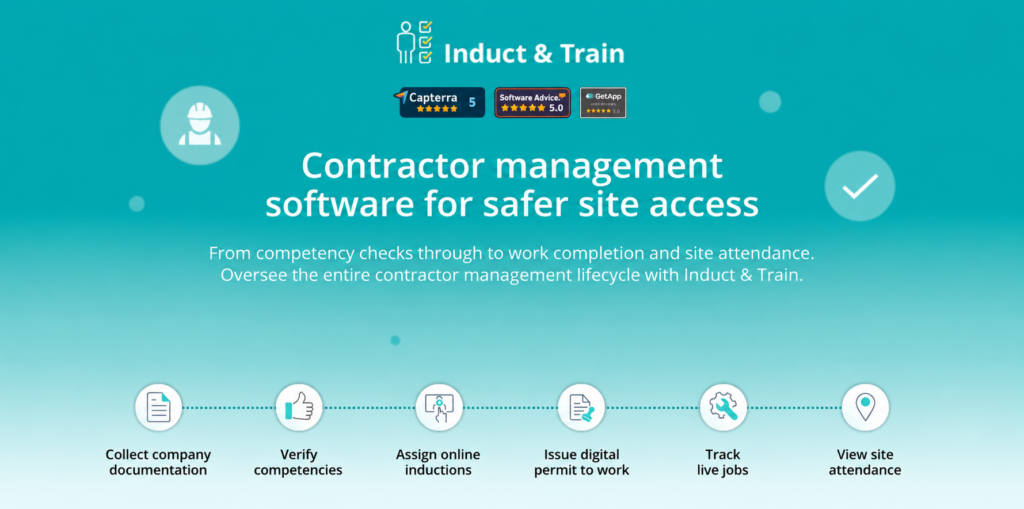
From contractor onboarding to site attendance with Induct & Train
Managing contractors shouldn’t mean searching through different systems every time you need an answer.
Induct & Train helps organisations bring key contractor processes together, from onboarding and induction through to competency management and site attendance.
With Contractor Management, organisations can create greater visibility of contractor information and outstanding requirements, helping teams spend less time piecing records together and more time dealing with the exceptions that actually need attention.
Because ultimately, contractor management shouldn’t just tell you who your contractors are.
It should help you understand who meets the requirements to work.
Want greater visibility and control over your contractor processes? Talk to us about Contractor Management with Induct & Train.


