
HSE Stress Management: A Practical Guide for Health & Safety Leaders
April signifies Stress Awareness Month in the UK. Observed since 1992, it serves as a reminder that health and safety extends beyond the physical.
In high-risk industries, attention often centres on visible hazards. Yet work-related stress remains one of the most significant and overlooked risks on site. It can affect decision-making, safety behaviour and overall wellbeing.
For Health & Safety Managers, HSE stress management is not separate from safety – it’s fundamental to it.
The Scale Of The Problem
Stress continues to be among the leading causes of work-related ill health in the UK.
According to the Health and Safety Executive (HSE), over 900,000 workers experienced stress, depression or anxiety in 2024/25. Accounting for a significant proportion of working days lost annually. [Source].
The impact goes beyond wellbeing. Stress can lead to fatigue, reduced concentration and slower reactions.
All of which increase the likelihood of incidents, particularly in high-risk sectors such as construction, manufacturing and energy.
Why High-Risk Environments Amplify Stress
High-risk environments bring added pressures that can intensify stress if not managed properly.
Common factors include:
- High workloads and time pressure in safety-critical tasks
- Limited control over how work is carried out
- Gaps or inconsistencies in communication across teams
- The weight of responsibility where errors have serious consequences
- Challenging site conditions, including noise, isolation or hazardous surroundings
- Ongoing change across projects, teams or requirements
When these pressures build, they can affect performance, compliance and ultimately site safety.
HSE Stress Management: What The Standards Require
Under UK law, employers must assess and manage risks to workers’ health, including work-related stress.
The HSE Management Standards provide a structured approach to doing this. They focus on six areas that can contribute to stress at work:
- Demands – workload, work patterns and environment
- Control – how much say people have in their work
- Support – resources, encouragement and management
- Relationships – promoting positive behaviours and addressing conflict
- Role – clarity around responsibilities
- Change – how organisational change is handled and communicated
These standards help organisations move from reactive fixes to a more consistent, preventative approach.
They offer a practical way for SHEQ and HSE leaders to build stress management into existing risk processes. Rather than treating it as a standalone issue.
Spotting The Early Warning Signs On Site
Stress doesn’t always present clearly. On site, it often shows up through changes in behaviour or performance.
Guidance from ACAS highlights signs such as:
- Difficulty concentrating or making decisions
- Increased errors or near misses
- Becoming withdrawn or less communicative
- Irritability or tension within teams
- Higher levels of absence or reduced engagement
In a site environment, these signs can quickly translate into safety risks. Recognising them early and creating an environment where people feel able to speak up is essential.
From Awareness to Action
Awareness is important, but it only has value when it leads to action. The most effective organisations build stress management into everyday operations.
Build stress awareness into training
Stress awareness should be treated like any other safety-critical topic. Workers need to understand how stress affects performance, how to recognise it, and what support is available.
Create consistency across sites
Clear, standardised processes reduce uncertainty. When people know what is expected, it removes unnecessary pressure and supports safer working.
Ensure competence and readiness
Uncertainty is a key driver of stress. Making sure workers are properly inducted, trained and verified as competent helps build confidence and reduce risk.
Reducing Stress Through Better Systems
The right systems can play a practical role in reducing stress on site.
Digital tools that remove manual processes and reduce admin give managers more time to focus on their teams. Particularly those showing signs of stress.
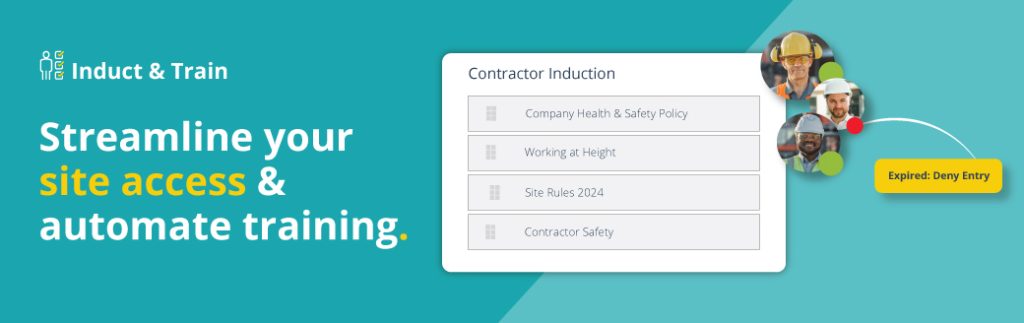
With Induct & Train, organisations can:
- Make stress awareness training a requirement for site access
- Reduce administrative burden and free up time for on-site support
- Ensure only qualified workers carry out high-risk tasks
- Provide clear workflows that remove uncertainty
- Maintain consistency and visibility across sites
When these controls are built into daily operations, stress management becomes part of how work is delivered – not an additional task.
Get in touch to learn how Induct & Train supports safer, more consistent site operations.
A Safer Site Starts With A Healthier Workforce
Stress is often seen as part of the job in high-risk environments.
But unmanaged stress is not inevitable. It is a risk that can be identified, assessed and reduced.
For SHEQ and HSE leaders, the priority is clear: treat stress with the same level of structure and attention as any other safety risk.


